Expert warning that variation in clay type and change of embankment design will lead to cost escalation and project overruns.

Notes on a visit to the reservoir trial site
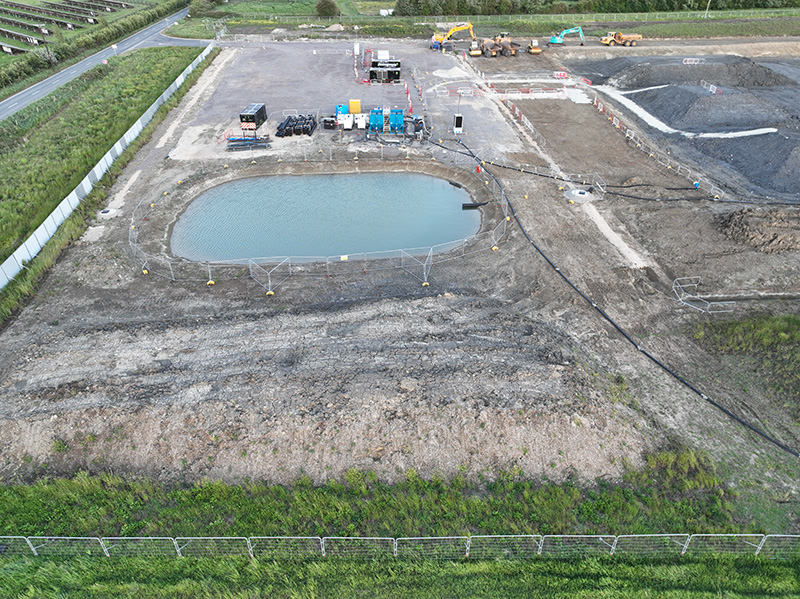
Notes on a visit to the reservoir trial site
Dr Julian Parfitt, FRSA, is an independent consultant, RSPB volunteer and biodiversity recorder. He was previously Technical Director (Food and Agriculture) in a global environmental consultancy where he worked on food supply chain sustainability issues. His environmental work and love of nature spans over 40 years, with his current focus being on local nature recovery and biodiversity projects.
During his consultancy career he has managed complex projects for commercial clients, academia, governmental departments/ European Commission and NGOs. He has delivered key strategic technical and advocacy projects, including as an advisor to the food waste reduction agreement in South Africa (2018-20, funded by EU), the UK House of Lords EU Committee’s inquiry into EU food waste policies (2013) and as a researcher on the Foresight Global Food and Farming Futures Project (2011).
His experience includes work with the Oxfordshire Nature Project as a biodiversity and mapping advisor and with Sustainable Wantage as the Wild Wantage Project Lead. He has been a volunteer warden at Otmoor for 5 years and is active within Oxfordshire CAGs, recording local biodiversity and supporting local nature recovery projects. Dr Parfitt has also been guest lecturer on the Circular Economy Module at Imperial College’s Centre for Environmental Policy since 2005.
Professor Chris Binnie is a civil engineer specialising in dam design and
construction. He has a degree in Mechanical Sciences and in law from
Cambridge University and completed the Imperial College post graduate course
in soil mechanics specialising in dam design. He has been a Fellow of the
Institution of Civil Engineers (ICE) since 1976. He became a Fellow of the
Chartered Institution of Water and Environmental Management (CIWEM) in 1976,
and was President in its centenary year, 1995. He was elected a Fellow of
the Royal Academy of Engineering in 1994. He was an Honorary Professor at
Kingston University from 1995-2007 and then at Exeter University 2008-2025
lecturing on dam design.
Chris was founder chairman of the CIWEM Water Resources Expert Panel in 1992
and continued to serve on it until 2022. He was a member of the ICE Water
Board from 1987 to 2019. He was a Panel Engineer under the Reservoirs Act
from 1980 to 2008 including serving on the ICE Reservoirs Committee and
interviewing candidates for Panel Engineer status. He has been a member of
the British Dams Society since 1973.
Chris worked for Binnie & Partners, the consulting engineering company
founded by his great grandfather, from 1969 to 1978 working primarily on dam
design including the 70m high Marchlyn dam. He was site staff on the
construction of the earth fill Grafham reservoir and the Farmoor reservoir.
He then joined WSAtkins as head of their water consultancy. His work
included the design of the 70m high Gargar dam, the detailed design of the
50m high Aid Zada dam, and the design verification of the 110m high Yuvecik
dam in an earthquake prone area in Tukey. He reported on the raising of the
existing Abberton dam, and on the Darwell dam, and on the design of 30m
high Broadoak dam in Kent. He was Construction Engineer for the Norton
Fitzwarren dam and Newdale reservoir. In 1994 he became a Main Board
Director of WSAtkins including floating the company.
John Lawson is a civil engineer specialising in water resources engineering with a degree in mechanical sciences from Cambridge University. Fellow of the Institution of Civil Engineers (ICE) since 1985 and of the Chartered Institution of Water and Environmental Management (CIWEM) since 1988, he was invited in 2002 to become a Fellow of the Royal Academy of Engineers in recognition of his contribution to water resources engineering.
He served on the Water Resources Expert Panel of CIWEM from 1994 to 2002 and was its Chairman from 1997 to 2002. He served on the Water Board of the Institution of Civil Engineers from 2002 to 2007, and was its Chairman from 2003 to 2007.
He worked for Halcrow Group Ltd., Consulting Engineers, from 1968 to 2007. Throughout his career he was engaged on projects for water supplies, flood control, irrigation and hydropower, becoming a Director of Halcrow Group Ltd. from 1990, and Managing Director of its water business from 2003 to 2007. He has been responsible for numerous water resource planning studies in England and Wales, with a particular focus on minimising the impact of abstractions on the environment.
From 1991 to 1994 he was responsible for Halcrow’s work assisting the National Rivers Authority to develop its water resource strategy for England and Wales, which was published in 1994. This involved helping the NRA and water companies to examine a wide range of strategic options to meet future demands, including the Severn transfer and the Abingdon reservoir. His role in this was project manager, coordinating the work of the NRA and all the water companies concerned, including assisting the NRA in analysing the strategic options and developing their strategy.
Since his retirement from Halcrow he has worked as a voluntary water resources adviser to Action for the River Kennet, and the Wye & Usk Foundation. He is also a Trustee of the Thames Restoration Trust. In 2007 he prepared a report for Halcrow on transferring water to the Thames catchment from Wales, including the Severn transfer.
Subscribe now to keep reading and get access to the full archive.